
Product Categories
PRODUCT CATEGORYContact Us
CONTACT USMobile phone:+86-15395152932
mail:jingliuup@outlook.com
Address:Electronic Information Industrial Park, Shunyi District, Beijing City
One-stop Charging Pile Assembly Line, complete assembly and testing.
Introduction to the Assembly System
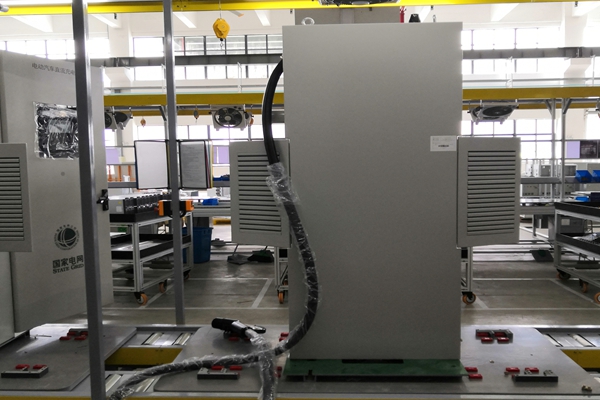
The image presents a state-of-the-art assembly line dedicated to the production of electric vehicle charging piles, specifically designed for high-capacity DC fast chargers and AC charging stations. This production system exemplifies modern modular manufacturing philosophy, where precision engineering meets scalable industrial workflow. The assembly line is engineered to accommodate the complete build-up of charging infrastructure units, from bare cabinet frames to fully integrated, test-ready products.
Part One: Line Architecture and Material Flow
Pallet-Based Conveyor Foundation. The foundation of this assembly system is a pallet-based conveyor system with precisely positioned locating fixtures. Each work station features a heavy-duty transport pallet, painted in industrial green and equipped with red clamping blocks, that secures the cabinet during assembly operations. This pallet conveyor approach enables synchronous or asynchronous movement between stations, allowing variable cycle times for complex operations while maintaining overall line throughput.
Linear Progressive Layout. The line layout follows a linear progressive assembly model, where charging pile cabinets move sequentially through defined process zones. Overhead, a yellow crane rail system provides auxiliary lifting capacity for heavy components such as power modules, transformer assemblies, and cable harnesses. This dual-mode material handling, conveyor for base units and overhead crane for heavy subassemblies, optimizes ergonomic conditions and reduces operator fatigue.
Part Two: Cabinet Assembly Process
Primary Product Description. The primary product visible in the image is a floor-standing DC charging pile cabinet, characterized by its rectangular steel enclosure, side ventilation louvers, and top cable exit routing. The assembly process for such units encompasses several critical stages that transform raw enclosures into fully functional charging infrastructure.
Stage 1: Cabinet Frame Integration. The process begins with the structural assembly of the cold-rolled steel enclosure. Operators mount the base frame, side panels, and rear doors, establishing the mechanical foundation. The louvered ventilation panels visible on the cabinet sides are installed at this stage, ensuring proper thermal management pathways for internal power electronics.
Stage 2: Internal Subassembly Installation. As the cabinet progresses along the line, internal mounting plates and DIN rails are positioned. This stage accommodates the installation of power distribution units, control circuit boards, communication modules, and safety interlock systems. The modular internal architecture allows for configuration flexibility, supporting various output ratings such as 60kW, 120kW, and 180kW within the same cabinet footprint.
Stage 3: Power Module and Cable Integration. The thick, corrugated cable assembly visible in the foreground represents the high-current DC output harness. During assembly, operators route heavy-gauge power cables from the internal rectifier modules through the cabinet top, preparing the charging gun interface. This cable management requires careful attention to bend radius specifications, electromagnetic shielding, and strain relief to ensure long-term reliability under repeated flexing cycles.
Stage 4: Pre-Test and Quality Verification. Before exiting the line, each unit undergoes preliminary electrical testing, including insulation resistance checks, continuity verification, and control system commissioning. The monitor screens visible in the background likely display test protocols and work instructions, ensuring standardized quality execution across all shifts.
Part Three: Process Engineering and Lean Principles
Lean Manufacturing Integration. This assembly line embodies several lean manufacturing principles essential to competitive EV infrastructure production. The clean, organized workstation layout minimizes non-value-added motion, while the open floor plan facilitates material replenishment via forklift or AGV delivery. The presence of multiple parallel stations suggests a mixed-model capability, enabling the line to produce different charger configurations, including wall-mounted AC units, pedestal-style DC chargers, and high-power fleet charging cabinets, with minimal changeover time.
Safety and Environmental Design. The yellow safety markings on the floor delineate pedestrian walkways, forklift lanes, and hazardous work zones, reflecting rigorous adherence to industrial safety standards. Additionally, the elevated windows and high-bay lighting design provide ample natural illumination, reducing eye strain during detailed wiring operations.
Part Four: Industry Context and Technical Significance
Scaling Challenges in EV Manufacturing. As global EV adoption accelerates, charging pile manufacturers face dual pressures: scaling production volumes while maintaining the extreme reliability standards demanded by grid-connected infrastructure. A well-engineered assembly line like the one depicted directly addresses this challenge. The standardized cabinet platform reduces engineering overhead, while the progressive assembly format enables workforce specialization, as operators develop expertise in specific integration tasks, improving both speed and quality consistency.
Market and Regulatory Context. The State Grid branding visible on adjacent equipment further contextualizes this facility within China’s national EV infrastructure build-out, where standardized charging protocols and centralized procurement drive manufacturing efficiency. For international markets, this production methodology translates directly, as the underlying electromechanical principles of charging pile construction remain consistent across regulatory jurisdictions, with adaptations primarily confined to software compliance and connector standards.
Part Five: System Design Highlights
Transport Mechanism. Pallet-based conveyor with green industrial pallets and red clamping blocks provides secure cabinet positioning throughout the assembly sequence.
Overhead Handling. Yellow crane rail system offers auxiliary lifting capacity for heavy power modules and transformer assemblies, reducing manual handling risks.
Workstation Configuration. Linear progressive layout with parallel stations supports mixed-model production of various charger configurations.
Cable Management. Corrugated high-current DC output harnesses require careful routing with attention to bend radius, shielding, and strain relief specifications.
Quality Verification. In-line pre-testing includes insulation resistance checks, continuity verification, and control system commissioning before final release.
Safety Infrastructure. Yellow floor markings, pedestrian walkways, and forklift lanes ensure clear separation of personnel and material movement.
Lighting Design. Elevated windows and high-bay fixtures provide natural illumination to reduce eye strain during detailed electrical assembly.
Conclusion
The assembly line captured in this image represents far more than a simple production conveyor. It is an integrated manufacturing system where mechanical precision, electrical safety, and process efficiency converge. From the pallet-based transport mechanism to the modular cabinet architecture, every element is optimized for the unique demands of EV charging equipment production.
As the electrification of transportation continues to reshape global manufacturing, such assembly systems will remain the critical backbone enabling the transition from prototype innovation to mass-market infrastructure deployment. This facility demonstrates how thoughtful production engineering can address the dual imperatives of volume scalability and quality consistency that define successful EV infrastructure manufacturing