Product Categories
PRODUCT CATEGORYContact Us
CONTACT USMobile phone:+86-15395152932
mail:jingliuup@outlook.com
Address:Electronic Information Industrial Park, Shunyi District, Beijing City
How to ensure uniform lamination gap of iron cores on the transformer assembly line?
Section A: Introduction to Modern Transformer Manufacturing
The transformer core assembly line represents a cornerstone of modern electrical equipment manufacturing, where precision engineering meets systematic production workflow. As a specialized production solution designed for transformer core and winding assembly, this line integrates advanced conveyor technology with meticulous manufacturing processes to optimize efficiency while maintaining the highest standards of electrical performance demanded by the power industry.
Section B: Assembly Line Architecture and Design
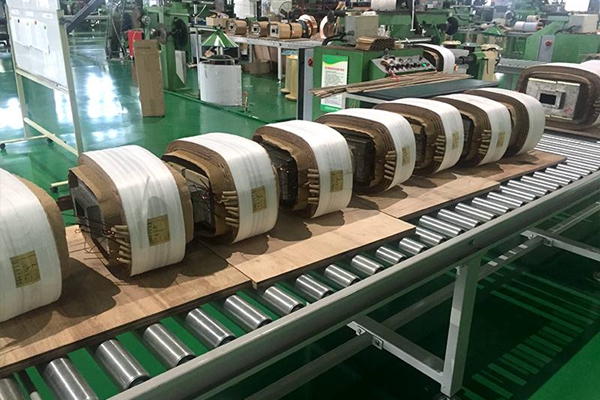
Conveyor System Foundation. The assembly line features a robust roller conveyor system engineered specifically for handling transformer core assemblies. Each transformer core, wrapped in protective insulating material, is positioned on individual wooden platforms mounted atop the roller conveyor, allowing smooth and controlled movement between assembly stations. The conveyor system is constructed with heavy-duty steel rollers mounted on reinforced frames, capable of supporting substantial core weights while ensuring minimal vibration during transit.
Linear Progression Layout. The line layout follows a linear progression model, where transformer cores move sequentially from one assembly station to the next. This arrangement facilitates a systematic workflow where each station focuses on specific operations, ranging from core lamination stacking to winding installation, insulation wrapping, and final testing. The spacious production floor, finished with green epoxy coating, ensures safe personnel movement and excellent visibility for quality monitoring throughout the manufacturing area.
Section C: Core Assembly Process and Workflow
Lamination Stacking and Core Formation. The manufacturing process begins with silicon steel lamination stacking, where individual steel sheets are precisely aligned and stacked to form the transformer core structure. As the core assembly advances along the conveyor line, technicians install primary and secondary windings around the core limbs. The roller conveyor system allows for 360-degree access to the transformer core, enabling winding operations from multiple angles without repositioning the main unit.
Critical Component Installation. Critical assembly stages include the installation of high-voltage and low-voltage winding coils, interlayer insulation, and core clamping structures. Each component must be precisely aligned and securely positioned according to engineering specifications. The assembly line design accommodates these requirements by providing stable positioning and adjustable work heights at each station. Technicians can rotate the core assembly using the conveyor platform’s mobility features, ensuring ergonomic working conditions and precise component placement.
Insulation Wrapping Phase. The insulation wrapping phase represents one of the most critical stages of the assembly process. Technicians apply multiple layers of insulating paper and pressboard around the winding assemblies, creating robust dielectric barriers between conductive components. The assembly line’s open design provides unrestricted access to all sides of the transformer core, facilitating complex insulation operations that demand meticulous attention to detail and adherence to electrical safety standards.
Section D: Winding and Interconnection Operations
Geometric Precision Requirements. The winding installation process requires exceptional precision, as the electromagnetic performance of the transformer depends entirely on the geometric accuracy of the coil assemblies. Technicians carefully position pre-formed copper or aluminum conductor windings onto the core limbs, maintaining precise inter-turn spacing and layer alignment. The roller conveyor system enables gradual rotation of the core assembly during winding operations, allowing uniform tension distribution and consistent coil geometry.
Lead Routing and Termination. Connection leads are routed through designated channels and terminated at appropriate bushings or terminal blocks. The assembly line’s design facilitates access to both the top and bottom of the transformer core, enabling technicians to complete lead connections without repositioning the assembly. This accessibility is crucial for maintaining consistent workmanship quality across all production units.
Section E: Quality Control Integration
In-Process Inspection Strategy. Quality assurance is embedded throughout the assembly process through strategically positioned inspection stations. At designated intervals along the conveyor line, transformer cores undergo dimensional verification, insulation resistance testing, and core loss measurement. The roller conveyor system enables quick repositioning of core assemblies for inspection purposes, allowing quality engineers to access all sides without manual lifting.
Automated Testing Integration. The intelligent aspects of the assembly line include integrated testing equipment that communicates with the conveyor control system. When a core assembly reaches a testing station, the conveyor automatically positions it at the optimal location for test probe connections. This integration reduces setup time between assembly and testing phases, contributing to overall production efficiency and minimizing the risk of human error during critical testing operations.
Specialized Test Procedures. Core loss testing and no-load current measurement are performed at dedicated testing stations equipped with specialized power analyzers. The conveyor system ensures precise positioning for safe and accurate electrical test connections, while protective barriers and grounding systems safeguard personnel during energized test procedures.
Section F: Material Handling and Logistics
Synchronized Component Delivery. The assembly line incorporates efficient material delivery systems that synchronize with the conveyor movement. Component kits, including silicon steel laminations, copper conductors, insulating materials, and structural hardware, are prepared at designated supply points along the line. This ensures technicians have immediate access to required parts without leaving their workstations. The roller conveyor’s smooth operation allows for consistent cycle times, enabling predictable material consumption rates and optimized inventory management.
Closed-Loop Platform Circulation. Empty platforms return to the line’s starting position through a parallel return conveyor or manual transfer system, creating a continuous loop of production capacity. This closed-loop material flow minimizes downtime between production cycles and maximizes the utilization of conveyor assets.
Section G: Safety and Ergonomics
Floor and Workspace Design. Safety considerations are paramount in the assembly line design. The green epoxy floor coating provides excellent visibility and slip resistance, while clearly marked pedestrian walkways delineate safe personnel movement paths from equipment zones. The roller conveyor system eliminates the need for manual transportation of heavy transformer cores, significantly reducing worker fatigue and the potential for musculoskeletal injuries.
Ergonomic Workstation Principles. Ergonomic principles guide the workstation design, with adjustable platform heights and accessible component mounting positions. The ability to rotate core assemblies on the roller platform allows technicians to maintain comfortable working postures throughout the assembly process, reducing strain during extended winding and insulation operations.
Section H: Production Efficiency and Scalability
Modular Expansion Capability. The modular design of the transformer core assembly line enables production scalability to meet varying demand levels. Additional stations can be integrated into the conveyor system without disrupting existing operations, allowing manufacturers to expand capacity as market requirements evolve. The standardized roller platform dimensions accommodate various core sizes, providing flexibility in production scheduling and enabling mixed-model production strategies.
Data-Driven Performance Management. Production tracking systems monitor core assembly progression along the line, capturing cycle times and identifying potential bottlenecks. This data-driven approach enables continuous improvement initiatives that enhance throughput and reduce manufacturing lead times. Real-time production dashboards provide visibility into line performance, enabling supervisors to make informed decisions regarding resource allocation and production scheduling.
Conclusion
The transformer core assembly line exemplifies modern manufacturing excellence through its integration of mechanical precision, automated material handling, and systematic quality control. The roller conveyor system serves as the operational foundation, enabling efficient workflow management while supporting the complex assembly requirements of transformer core and winding production.
As global electrical infrastructure demands continue to grow, such advanced assembly solutions position manufacturers to deliver reliable, high-performance transformer products that meet stringent industry standards and customer expectations. This assembly line represents not merely a production facility, but a comprehensive manufacturing ecosystem where engineering expertise, operational efficiency, and quality assurance converge to produce electrical equipment that forms the backbone of power transmission and distribution systems worldwide.