
Product Categories
PRODUCT CATEGORYContact Us
CONTACT USMobile phone:+86-15395152932
mail:jingliuup@outlook.com
Address:Electronic Information Industrial Park, Shunyi District, Beijing City
Pole-Mounted Switch Production Line: Three Roles in One Line — Switchgear, Pole-Mounted Switch and Roller Conveyor
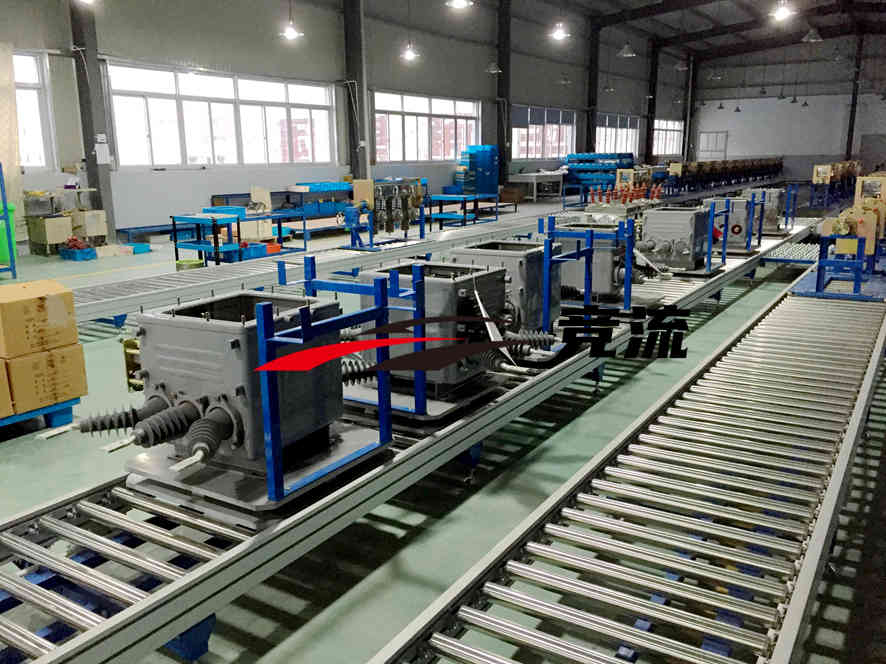
Walking into a workshop that produces pole-mounted switches, you see a scene like this: on a green anti-static epoxy floor, a roller conveyor runs through the workshop, carrying rows of dark grey switch enclosures. Black insulating bushings protrude from the sides of the enclosures, with connecting rods and operating handles exposed. Workers stand at fixed workstations performing assembly and inspection, while the products move forward station by station along the roller conveyor.
The line looks simple, but behind it is a combination of three “roles”: the switchgear being manufactured (the pole-mounted switch), the roller conveyor that carries it, and the process that ties them together. Understand these three separately, and the whole line becomes clear.
1. Switchgear: The “Switch Manager” of the Distribution Network
First, let’s get to know what is being made. Switchgear, in simple terms, is a complete set of switch devices in which high-voltage electrical components — load switches, circuit breakers, disconnectors, fuses, instrument transformers and the like — are assembled into a metal enclosure by circuit loop. It does three things: connecting and interrupting circuits, protecting equipment, and isolating faults.
By voltage class, switchgear is commonly found as 10kV and 35kV medium voltage switchgear, as well as low voltage distribution panels. By function, there are incoming feeder panels, outgoing feeder panels, tie panels, metering panels, PT panels, and more. For distribution networks, there are also compact ring main units — all belong to the switchgear family, sharing the common feature of “housing high-voltage components in an enclosure, isolating them with insulating media, and operating open/close via operating mechanisms.”
The rows of grey cabinets in urban distribution rooms, residential substations and factory substations are switchgear. It is the “switch manager” of the distribution network — deciding where power is supplied, cut off or isolated.
2. Pole-Mounted Switch: The “Outdoor Switch” on Utility Poles
The pole-mounted switch is the “outdoor member” of the switch family. Instead of sitting inside an enclosure or taking up ground space, it is installed directly on the poles of 10kV overhead distribution lines, used to break, close and carry the load current and fault current of the line. Overhead lines stretch for kilometers, and switches are needed along the way to sectionalize, tie and isolate faults — that is exactly what pole-mounted switches do.
Pole-mounted switches fall into three categories by interrupting capability:
- Pole-mounted disconnector: has a visible break, used to isolate the power source during maintenance; not allowed to operate under load;
- Pole-mounted load break switch: can make and break normal load current (typically ≤630A) but cannot interrupt fault current; mainly used for line sectionalizing and fault isolation;
- Pole-mounted circuit breaker: can interrupt fault current (≥20kA) and provides short-circuit protection for the line; the most fully-featured type.
Its characteristics are all designed for the “outdoor, pole-mounted” environment:
- Fully sealed structure: the switch body and operating mechanism are fully sealed, moisture-proof and condensation-resistant, suitable for hot, humid and freezing outdoor environments;
- Reliable arc extinction: mainstream products use vacuum interrupters or SF6 arc extinction, offering stable interrupting performance, no risk of combustion or explosion, and maintenance-free operation;
- Diverse operating mechanisms: spring-operated or permanent magnet mechanisms, operable manually or electrically, with remote control via controllers;
- Automation-ready: works with FTU (Feeder Terminal Unit) to provide remote control, remote measurement and remote signaling, enabling distribution network automation.
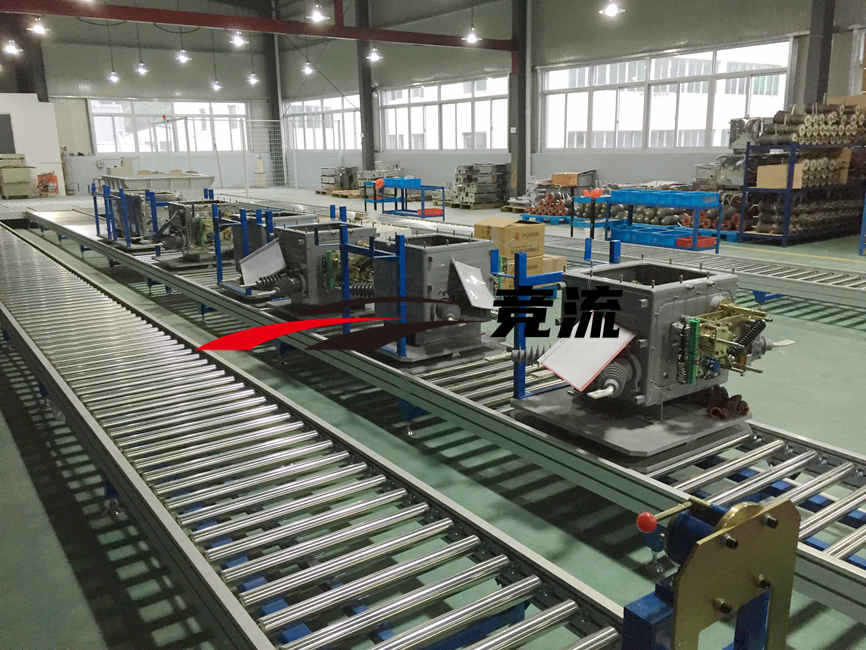
The role of the pole-mounted switch in one sentence: rapidly isolate faults to minimize outage scope, and perform load switching and line sectionalizing under normal conditions — it is key equipment for the safe operation of distribution networks. In its typical structure, insulating bushings (porcelain or silicone rubber), operating mechanisms, contact and arc-extinguishing components, and current transformers are the core parts — the black bushings and connecting rod handles visible in the photos correspond to these components.
3. Roller Conveyor: The “Conveyor Belt” of the Line
A complete pole-mounted switch weighs several hundred kilograms. Moving it by manpower is impractical; moving it by overhead crane is inefficient. This is where the roller conveyor comes in.
The roller conveyor (also known as roller conveyor or roller bed conveyor, Roller Conveyor) is a continuous conveying device that uses rows of rollers as the load-carrying elements and moves materials by roller rotation. Its structure is simple: rollers, frame, legs and drive unit. By drive type, there are powered roller conveyors and gravity (non-powered) roller conveyors; by layout, there are straight, curved and inclined types.
Its characteristics match the needs of a pole-mounted switch line exactly:
- High load capacity: can convey items of very large single-piece weight and withstand impact loads; chain drive is used for heavy-duty applications;
- Simple, reliable and easy to maintain: rollers plus frame, easy to install and dismantle; routine maintenance is just checking rollers and bearings;
- Flexible layout: can be assembled into straight, curved, diverging and converging configurations; multiple roller lines can combine with lift transfer units and special machines into a complete logistics system;
- Accumulation and buffering: accumulation rollers allow material stacking and buffering, automatically regulating supply between upstream and downstream stations to balance line takt;
- Adjustable speed and interlocking: variable frequency speed control and PLC control, with photoelectric sensors for automatic start/stop and collision prevention.
Its role is easy to understand: linking scattered workstations into one line, letting the product move instead of the workers, and keeping heavy loads off manual handling — the double-row roller conveyor carrying switch bodies smoothly through the photos is a direct illustration of this role.
4. The Three Combined: A Pole-Mounted Switch Production Line
Put the three together, and the logic of the line becomes clear:
The roller conveyor is the “road”, handling the conveying and positioning of switch bodies; the workstations are the “stops”, arranged on both sides of the conveyor with workers and test equipment fixed in place; the pole-mounted switch is the “cargo”, traveling station by station through all operations along the conveyor.
Specific stages visible in the photos: the switch bodies on the conveyor have connecting rods, shafts and red handles on the sides (the operating mechanism), and some enclosures expose three-phase insulating bushings — indicating they have gone through assembly and are in the transfer or inspection stage. The red-bordered document clipped to the enclosure is the work instruction and inspection record sheet, corresponding to the inspection workstation, where SOPs travel with the product and quality control points are clearly traceable.
A typical pole-mounted switch production line follows roughly this process:
Enclosure and insulating parts loading → insulating bushing installation → operating mechanism assembly and adjustment → contact and arc-extinguishing component assembly → current transformer installation → mechanical characteristic inspection (open/close testing) → electrical inspection (insulation / withstand voltage) → inspection record signing → labeling and packaging → line-off.
The reason for using a production line instead of scattered bench assembly comes down to three characteristics of the pole-mounted switch: heavy body (manual handling is labor-intensive and poses injury risk), demanding outdoor requirements (full sealing, insulation, and mechanical life all have hard specifications), and extensive testing (every unit must pass mechanical characteristic and electrical inspection). The roller conveyor plus fixed-workstation model solves the handling problem and embeds inspection into the process in a standardized way — inspection records travel with the product, so who assembled it, who inspected it, and what the results were are all traceable.
Conclusion
A pole-mounted switch production line, taken apart, is just three points of knowledge: switchgear is the “thing being made,” the pole-mounted switch is its outdoor branch, and the roller conveyor is the “handling tool.” Understand these three, and when you look at the roller conveyor in the workshop again, you will see that what it carries is not just a few hundred kilograms of metal enclosure, but the entire manufacturing logic of distribution equipment.