
Product Categories
PRODUCT CATEGORYContact Us
CONTACT USMobile phone:+86-15395152932
mail:jingliuup@outlook.com
Address:Electronic Information Industrial Park, Shunyi District, Beijing City
High Voltage Switchgear Assembly Line
Location:Home >> PRODUCTS >> High Voltage Switchgear Assembly Line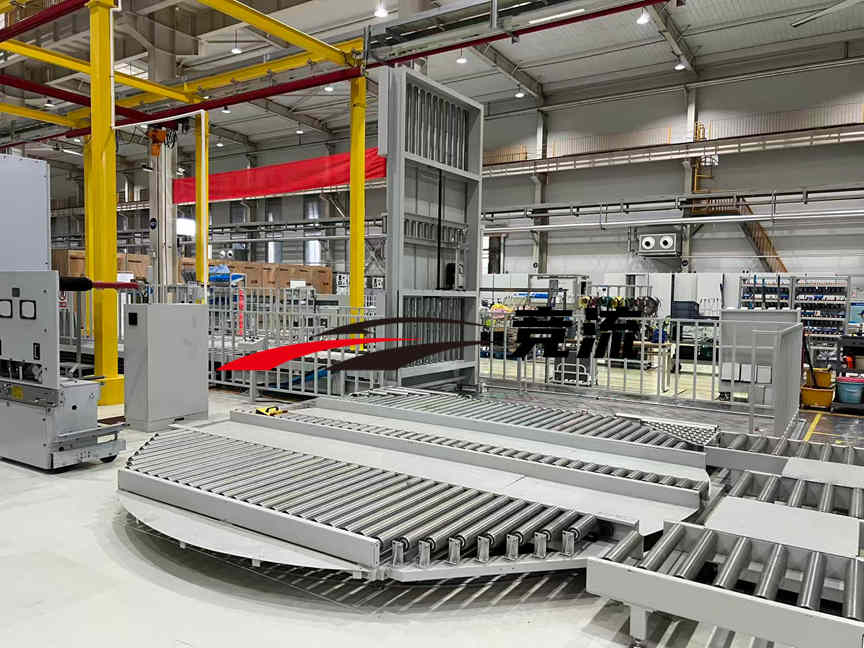
High Voltage Switchgear Assembly Line
1. Overview and Production Line Description 1.1 Production Line Overview A high ...
Details
1. Overview and Production Line Description
1.1 Production Line Overview
A high voltage switchgear assembly line is an automated assembly and conveying system for complete high-voltage switchgear equipment. It integrates roller conveyors, rotary turntables, vertical lifters, and other units to complete workstation transfer, directional transfer, and cross-floor circulation of high-voltage cabinet bodies. It is suitable for the mass assembly of high-voltage switchgear, distribution cabinets, and other complete power equipment.
This high voltage switchgear assembly line adopts a heavy-duty roller conveyor system that carries cabinet pallets for inter-station transfer. A rotary turntable mechanism enables 90°/180° rotation of the cabinet workstation, allowing assembly and wiring from multiple angles without manual handling or flipping of the cabinet. A reciprocating vertical lifter handles the cross-floor transfer and return circulation of pallets and cabinets, forming a three-dimensional closed-loop logistics system that makes full use of vertical plant space.
Each workstation is equipped with electrical test tooling to complete component assembly, wiring, and performance testing. Workstations are separated by protective fencing to ensure personnel and equipment safety. The complete line reduces manual handling, lowers labor intensity, and improves both assembly consistency and production efficiency.
1.2 Switchgear Classification and Structure
High voltage switchgear is an AC metal-enclosed switchgear for 3.6kV–40.5kV, responsible for receiving, distributing, switching, controlling, and protecting electrical power, with safety ensured by a five-prevention interlock system.
By circuit breaker installation:
- Removable (draw-out) type: represented by KYN28A-12 and KYN61-40.5, the circuit breaker is mounted on a draw-out truck, allowing maintenance without power interruption;
- Fixed type: represented by XGN and GG series, the circuit breaker is fixed to the cabinet, offering a simple structure and lower cost;
- Compact ring main unit: represented by the HXGN series, small in size and expandable, suitable for ring network power supply units.
By voltage class: 12kV, 24kV, and 40.5kV.
By insulation medium: air-insulated (AIS), SF₆ gas-insulated (GIS), and solid-insulated, corresponding to different protection levels and applications.
By installation environment: indoor type and outdoor type.
Cabinet structure: made of aluminum-zinc coated steel plate or cold-rolled steel plate, CNC-processed and assembled by bolting or welding. Internal metal partitions divide the cabinet into independent compartments—the busbar chamber, circuit breaker chamber, cable chamber, and relay & instrument chamber—which isolate arcs and prevent propagation in case of fault. The cabinet doors, partitions, and grounding system together form a complete protection system.
Core components:
- Primary components: vacuum circuit breaker, disconnector, earthing switch, current transformer (CT) / voltage transformer (PT), surge arrester, main busbar;
- Secondary circuit: microprocessor protection device, measuring instruments, terminal blocks, secondary wiring harness.
Relevant standards: GB 3906, DL/T 404, GB/T 7251, IEC 62271 series.
1.3 Assembly Process and Line Composition
The typical assembly process of high voltage switchgear:
Cabinet frame assembly → primary component assembly → busbar assembly (bending, punching, embossing, lapping, contact resistance ≤50μΩ) → secondary wiring (harness layout, numbering, tying, continuity testing) → functional commissioning (opening/closing, five-prevention interlock, protection operation) → final inspection (loop resistance, insulation resistance, power-frequency withstand voltage, grounding continuity, mechanical characteristics) → packaging and storage.
Secondary wiring is labor‑intensive and busbar assembly demands high precision, placing strict requirements on assembly posture, station takt time, and consistency.
For the above process, the high voltage switchgear assembly line adopts the industry-standard combination of “heavy-duty power roller conveyor + rotary turntable + vertical lifter + circulating return”, suitable for heavy switchgear such as GGD and KYN (single cabinet 500kg–2.5t). System composition:
| No. | Unit | Function |
|---|---|---|
| 1 | Heavy-duty power roller conveyor (straight + curve sections) | Carries pallets and cabinets, main inter-station transfer |
| 2 | Rotary turntable mechanism (90°/180°) | Rotates cabinet workstation for multi-angle assembly/wiring |
| 3 | Reciprocating vertical lifter | Cross-floor transfer of pallets and cabinets |
| 4 | Pallet | Carries cabinet, circulates with the line |
| 5 | Assembly workstation | Electrical/air/network interfaces for assembly, wiring, testing |
| 6 | Protective fence and safety isolation system | Inter-station isolation for personnel and equipment safety |
| 7 | Centralized electrical control system (PLC + HMI + e-stop + alarm) | Line-wide takt control, connectable to MES/WMS, barcode/RFID |
The quantity, number of sections, and lift stops of each unit can be adjusted according to workshop layout, cabinet specification, and production takt, with reserved interfaces for future capacity expansion.
2. Operation Process (Workstation Transfer Logic)
Loading → conveying → turning → assembly/wiring → testing → turning → cross-floor return → unloading, running in a closed loop:
- Loading: The cabinet frame is placed on the pallet and enters the main line via the heavy-duty roller conveyor;
- Station conveying: The powered rollers are driven in sections; the pallet carries the cabinet sequentially to the primary component assembly, busbar assembly, and secondary wiring stations. Each station is equipped with a stop cylinder and lifting mechanism for positioning and accumulation;
- Turning: At the rotary turntable, the cabinet rotates 90° or 180° as required, allowing operators to assemble and wire from multiple angles without manual handling or flipping;
- Assembly and testing: Each station is equipped with electrical test tooling to complete component assembly, wiring, loop resistance / insulation resistance / continuity testing, etc., with protective fencing between stations;
- Cross-floor circulation: At the end of the main line, the vertical lifter transfers the pallet and cabinet up or down to another floor; the pallet return forms a three-dimensional closed loop, making full use of vertical space and saving floor area;
- Unloading: The finished cabinet is unloaded at the designated station, goes through final tests such as withstand voltage and five-prevention interlock verification, and is packed and stored after passing; the pallet automatically returns to the loading end for reuse.
3. Technical Parameters (All Customizable)
The following are reference ranges. All parameters are determined on-site based on cabinet specification, building floor height, and production takt, supporting non-standard customization. The standard workstation reference size is 1.8m (W) × 1.5m (L), with double-sided powered rollers, a conveying surface height of approx. 380mm, roller diameter D76, and spacing 120mm.
3.1 Roller Conveyor
- Roller diameter: D50 / D76 / D89 (optional)
- Roller pitch: 55 / 120 mm (determined by cabinet bottom dimensions)
- Conveying height: approx. 380 mm (adjustable)
- Conveying speed: 0.1–12 m/min, sectionally variable frequency adjustable
- Single-unit load: ≤ 2000 kg (extendable for heavy-duty type)
- Drive: gearmotor + chain drive, three-phase 380V; independently driven per station
- Frame: carbon steel with plastic coating / stainless steel (optional)
3.2 Rotary Turntable
- Turning angle: 90° / 180° (configurable)
- Load capacity: ≤ 2000 kg
- Drive: gearmotor + slewing bearing, positioning accuracy ±1°
3.3 Vertical Lifter
- Type: reciprocating (Z-type / C-type in/out optional)
- Lift height: 3–30 m (determined by floor)
- Rated load: 200–3000 kg (extendable to 5000 kg for heavy-duty)
- Lift speed: < 30 m/min (adjustable)
- Number of stops: determined by building (multiple stops optional)
- Control: PLC + frequency converter, connectable to MES/WMS
3.4 Pallet and Workstation
- Pallet dimensions: determined by cabinet outline (non-standard available)
- Workstation size: reference 1.8 m (W) × 1.5 m (L), adjustable
- Per-station configuration: 220V power outlet, pneumatic quick coupling, network interface
- Applicable cabinets: KYN28, KYN61, XGN, HXGN, etc., voltage classes 12 / 24 / 40.5 kV
3.5 Complete Line
- Design takt: determined by capacity requirement (reference: 1 unit / 24 min)
- Annual capacity: determined by shifts and working days
- Control mode: centralized line control, HMI + e-stop + call + job-complete signal + audible/visual alarm
- Safety: protective fence (1.2 m high) + limit protection + anti-collision device + zone interlock
High Voltage Switchgear Assembly LineQuote----High Voltage Switchgear Assembly LineFor the latest case images, please contact us for more specific information