
Product Categories
PRODUCT CATEGORYContact Us
CONTACT USMobile phone:+86-15395152932
mail:jingliuup@outlook.com
Address:Electronic Information Industrial Park, Shunyi District, Beijing City
Circuit Breaker Assembly Line, no jamming and durable after repeated switching!
Integrated Conveyor Systems for Electrical Component Manufacturing
Introduction
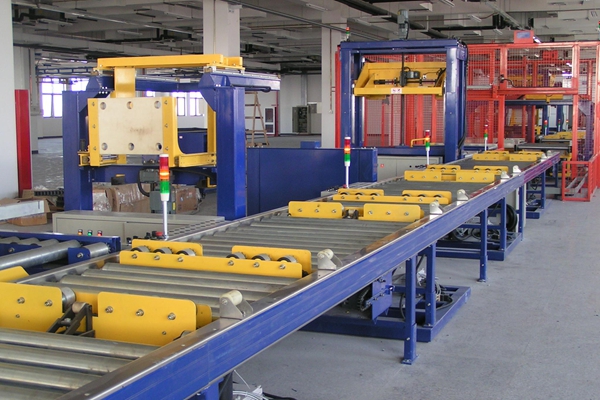
Our circuit breaker assembly line represents a purpose-built manufacturing system engineered for the systematic production, testing, and packaging of low-voltage electrical protection devices. The photograph captures a multi-stage production environment centered on a robust roller conveyor platform, integrated with automated end-of-line equipment and real-time process monitoring systems. This configuration reflects a balanced approach between manual assembly operations and automated material handling, designed to meet the stringent quality and safety standards governing electrical switchgear manufacturing.
Roller Conveyor Platform: The Production Backbone
Chain-Driven Live Roller Design. The foundation of this assembly system is a powered roller conveyor, specifically a chain-driven live roller conveyor with segmented, modular construction. Unlike belt or chain conveyors that carry products directly, this roller-based system supports individual pallets or fixture plates that carry circuit breaker housings and subassemblies through the production sequence. The steel rollers, mounted on precision bearings, provide smooth, low-friction transport while accommodating the weight of assembled breaker units and their associated tooling.
Structural Engineering. The conveyor’s blue-painted steel frame is engineered for structural rigidity and includes adjustable-height support legs, allowing the entire line to be leveled to precise tolerances regardless of floor conditions. The segmented design visible in the photograph, with distinct conveyor modules joined end-to-end, enables the line to be extended, shortened, or re-routed to accommodate different plant layouts or production volumes. Each module incorporates its own drive motor and chain transmission, ensuring consistent roller speed across the entire line length and preventing product accumulation at module junctions.
Pallet Block System. A notable feature is the yellow pallet or fixture blocks positioned at regular intervals along the conveyor. These blocks serve as product carriers and positioning stops, ensuring that each circuit breaker arrives at a workstation in a consistent orientation and location. The blocks incorporate side-guide features and possibly pneumatic clamping mechanisms to secure the product during assembly and testing operations, preventing displacement during high-torque fastening or vibration testing.
Automated End-of-Line Integration
Gantry-Style Machine. At the upstream end of the line, the photograph reveals a large gantry-style automated machine, likely a case or carton packing system, or possibly an automated testing station. This blue and yellow structure spans across the conveyor path, indicating that it operates on products as they pass through its work envelope. The overhead gantry design maximizes floor space utilization while providing clear access to the conveyor for maintenance and manual intervention.
Safety Zoning. Adjacent to this unit, additional automated stations are visible in the background, enclosed within red safety fencing. This color-coded safety zoning, red for automated, guarded zones and blue for operator-accessible areas, follows established industrial safety conventions and ensures that personnel are visually alerted to areas where automated machinery operates without direct human supervision. The safety enclosures likely house robotic assembly cells, automated screw-driving stations, or high-voltage testing equipment where operator proximity would present a hazard.
Process Monitoring and Andon Signaling
Visual Management System. Distributed along the conveyor at regular intervals are stack-light assemblies with red, amber, and green illumination segments. These andon signaling devices are a cornerstone of lean manufacturing visual management systems. Each light communicates the operational status of its associated workstation. Green indicates normal operation. Amber signals a call for assistance or a minor delay. Red denotes a line stoppage requiring immediate attention. The vertical positioning of these lights ensures visibility from a distance, allowing supervisors and maintenance personnel to assess line-wide status at a glance and respond proactively to emerging issues.
OEE Strategy Integration. This real-time status communication system is integral to the assembly line’s overall equipment effectiveness strategy. By immediately flagging deviations from standard cycle times, the andon system enables rapid root-cause analysis and corrective action, minimizing unplanned downtime and preventing the propagation of quality defects downstream.
Assembly Process Flow and Workstation Sequencing
Progressive Assembly Sequence. The linear layout of the conveyor suggests a progressive assembly sequence typical of circuit breaker manufacturing. Products enter the line at the far end, nearest the automated gantry, and progress toward the foreground, accumulating value at each station along the way. The process sequence would typically include housing preparation and component insertion, contact assembly and spring loading, arc chute installation, thermal and magnetic trip unit calibration, mechanical endurance testing, dielectric withstand testing, and final labeling and packaging.
Line Pitch Calculation. The spacing between the yellow pallet blocks corresponds to the line’s pitch, the center-to-center distance between workstations. This pitch is carefully calculated based on the longest operation in the assembly sequence, ensuring that no station becomes a bottleneck while avoiding excessive idle time at faster stations. The conveyor’s indexing capability, moving the line forward in discrete steps rather than continuous motion, allows operators to work on stationary products, improving precision and reducing ergonomic strain.
Material Handling and Work-in-Process Management
Controlled Buffering. The conveyor system serves as both a transport mechanism and a controlled buffer for work-in-process inventory. The spacing between pallet blocks allows a limited number of products to queue between stations, absorbing minor variations in cycle time without stopping the entire line. This decoupling of stations is essential for maintaining overall throughput when individual operations experience temporary delays.
Logistics Interface. Raw components and subassemblies are likely delivered to the line via kitting carts or automated guided vehicles that interface with the conveyor at designated drop points. Finished products, after passing through the automated gantry station, whether for testing, packing, or palletizing, are transferred to outbound logistics systems for distribution.
System Design Highlights
Conveyor Type. Chain-driven live roller with segmented modular construction provides smooth, low-friction transport for circuit breaker housings and subassemblies.
Frame Construction. Blue-painted steel frame with adjustable-height support legs ensures precise leveling regardless of floor conditions.
Module Configuration. Distinct conveyor modules with individual drive motors and chain transmissions enable line extension, shortening, or re-routing for different plant layouts.
Product Carriers. Yellow pallet blocks with side-guide features and pneumatic clamping maintain consistent product orientation and location at each workstation.
Automated Integration. Gantry-style machine spanning the conveyor path handles end-of-line testing, packing, or palletizing while maximizing floor space utilization.
Safety Zoning. Red fencing encloses automated stations while blue-painted areas designate operator-accessible zones, following established industrial safety conventions.
Andon System. Stack-light assemblies with red, amber, and green segments provide real-time workstation status communication for proactive issue response.
Line Pitch. Center-to-center workstation spacing calculated based on longest operation duration prevents bottlenecks and balances workflow across all stations.
Indexing Control. Discrete-step advancement allows operators to work on stationary products, improving precision and reducing ergonomic strain.
Conclusion
This circuit breaker assembly line demonstrates a well-engineered integration of roller conveyor technology, automated end-of-line processing, and lean visual management systems. Its modular conveyor architecture provides the flexibility to adapt to evolving product designs and production volumes, while the andon signaling and safety zoning systems ensure that operational efficiency is pursued without compromising worker safety or product quality.
For manufacturers of electrical protection devices, this type of configurable, semi-automated assembly system offers a proven pathway to achieving consistent output, regulatory compliance, and competitive manufacturing economics in a demanding industrial market.