Product Categories
PRODUCT CATEGORYContact Us
CONTACT USMobile phone:+86-15395152932
mail:jingliuup@outlook.com
Address:Electronic Information Industrial Park, Shunyi District, Beijing City
This High Voltage Switchgear Assembly Line replaces hundreds of workers’ workload!
Roller Conveyor Systems for Electrical Power Distribution Manufacturing
Introduction
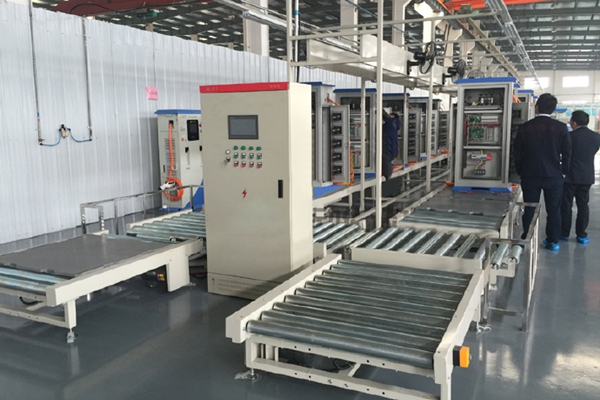
Our high voltage switchgear assembly line represents a purpose-engineered production system designed for the assembly, testing, and commissioning of medium-to-high voltage electrical distribution equipment. The photograph captures a sophisticated manufacturing environment built around a gravity and powered roller conveyor network, integrated with centralized process control, overhead material handling infrastructure, and modular workstation architecture. This configuration reflects the specialized requirements of switchgear manufacturing, where product size, weight, and electrical safety standards demand robust material handling solutions and rigorous process control.
Roller Conveyor System: Multi-Modal Material Handling
Hybrid Conveyor Platform. The core of this assembly system is a hybrid roller conveyor platform combining both gravity-fed and powered roller sections to optimize material flow and energy efficiency. The foreground shows a gravity roller conveyor section, identifiable by its slight downward pitch and lack of external drive motors. This section relies on gravitational force to move switchgear cabinets and subassemblies from one workstation to the next, reducing power consumption and maintenance requirements in areas where controlled descent is sufficient.
Powered Roller Modules. Adjacent to the gravity section, powered roller conveyor modules provide the motive force required for horizontal transport and uphill segments. The steel rollers, mounted in precision-machined frames with galvanized or zinc-plated finishes, offer high load-bearing capacity essential for switchgear enclosures that can weigh several hundred kilograms when fully populated with circuit breakers, bus bars, and instrumentation. The roller spacing is carefully specified to support the switchgear base frames without sagging, ensuring smooth transport even for partially assembled units with uneven weight distribution.
Modular Frame Construction. The conveyor’s modular white-painted steel frame incorporates adjustable-height support legs with swivel casters or fixed feet, allowing rapid leveling and reconfiguration. The visible junction between conveyor segments, where gravity and powered sections meet, includes transfer mechanisms that bridge the gap while maintaining product stability. This modularity is critical for switchgear manufacturers who must accommodate varying cabinet dimensions across different voltage classes and product families.
Centralized Process Control and Line Management
PLC Hub and HMI Station. A prominent feature in the photograph is the freestanding control cabinet positioned at the conveyor junction. This unit serves as the line’s programmable logic controller hub and human-machine interface station, consolidating control over conveyor speed, indexing, safety interlocks, and workstation sequencing. The HMI touchscreen provides operators and supervisors with real-time visibility into line status, production counts, alarm conditions, and diagnostic information.
Manual Override Capability. The control panel’s pushbutton array and indicator lights enable manual override of automated sequences during setup, maintenance, or fault recovery. The red warning symbol on the cabinet door indicates the presence of high-voltage or energized electrical systems within the control architecture, reinforcing safety awareness for maintenance personnel. This centralized control approach ensures consistent operation across all conveyor modules and facilitates integration with higher-level manufacturing execution systems for production scheduling and traceability.
Overhead Monorail and Material Delivery System
Dual-Purpose Infrastructure. Spanning the length of the assembly hall is an overhead monorail or power-and-free conveyor system, suspended from the building’s structural steel framework. This overhead infrastructure serves dual purposes. It delivers raw materials, subassemblies, and tooling to individual workstations via hoists or trolleys. It provides a transport pathway for completed switchgear units to be moved from the end of the line to testing bays or shipping areas.
Three-Dimensional Material Flow. The overhead system’s integration with the floor-level conveyor creates a three-dimensional material flow network. Components descend from the overhead system to the assembly line at designated drop points, while finished products move horizontally along the roller conveyor to the line’s terminus. This separation of inbound material flow via overhead and outbound product flow via floor-level minimizes congestion and reduces the risk of damage to sensitive electrical components during transport.
Workstation Architecture and Assembly Sequencing
Linear Progression. The assembly line is segmented into discrete workstations, each defined by the switchgear cabinet positioned at that location. The blue-topped enclosures visible along the line represent partially assembled switchgear units at various stages of completion. The linear progression from the background toward the foreground suggests a logical assembly sequence: enclosure frame preparation, bus bar installation, circuit breaker insertion, control wiring and termination, protective relay mounting, and final front panel fitting.
Index-and-Dwell Operation. Each workstation is supported by the roller conveyor’s ability to hold the switchgear cabinet in a fixed position during assembly operations. The conveyor may incorporate pneumatic or mechanical stop mechanisms that arrest product motion at each station, releasing the unit only when the operator or automated system confirms completion of the assigned tasks. This index-and-dwell operation mode ensures that assembly personnel can work on stationary products, improving precision and reducing the risk of dropped components or misaligned fasteners.
Quality Assurance and Testing Integration
In-Process Testing Capability. High voltage switchgear manufacturing demands rigorous quality control, including dielectric withstand testing, contact resistance measurement, and mechanical operation verification. The assembly line’s design accommodates these requirements by providing electrical test connections at designated stations, allowing in-process testing without removing the product from the conveyor. The control system can sequence the line to pause at test stations for extended dwell periods, ensuring that each unit receives adequate testing time without disrupting overall throughput.
Controlled Manufacturing Environment. The clean, epoxy-coated floor and corrugated metal wall partitions visible in the background indicate a controlled manufacturing environment that minimizes dust and contamination. These factors are critical for electrical equipment that must operate reliably for decades in demanding utility and industrial applications.
System Design Highlights
Conveyor Type. Hybrid gravity and powered roller platform with galvanized or zinc-plated steel rollers provides energy-efficient material flow and high load-bearing capacity for heavy switchgear enclosures.
Gravity Sections. Slight downward pitch sections without external drive motors reduce power consumption and maintenance requirements in controlled descent areas.
Powered Modules. Motor-driven roller sections provide motive force for horizontal transport and uphill segments where gravity alone is insufficient.
Frame Construction. Modular white-painted steel frame with adjustable-height support legs and swivel casters enables rapid leveling and reconfiguration for different cabinet dimensions.
Transfer Mechanisms. Junction points between gravity and powered sections include bridging components that maintain product stability during transitions.
Control Cabinet. Freestanding PLC hub with HMI touchscreen consolidates control over conveyor speed, indexing, safety interlocks, and workstation sequencing with manual override capability.
Overhead Monorail. Suspended power-and-free conveyor system delivers materials to workstations via hoists and transports completed units to testing bays or shipping areas.
Three-Dimensional Flow. Separation of inbound material flow overhead and outbound product flow at floor level minimizes congestion and protects sensitive components.
Index-and-Dwell Operation. Pneumatic or mechanical stop mechanisms hold cabinets stationary during assembly, releasing only upon task completion confirmation.
In-Process Testing. Designated stations with electrical test connections allow dielectric withstand testing and contact resistance measurement without removing products from the conveyor.
Conclusion
This high voltage switchgear assembly line exemplifies the integration of gravity and powered roller conveyor technology, centralized process control, and overhead material handling infrastructure tailored for heavy electrical equipment manufacturing. Its modular architecture supports product variety across different voltage classes and configurations, while the PLC-based control system ensures consistent operation, traceability, and safety compliance.
For manufacturers of power distribution equipment, this type of robust, configurable assembly system provides the foundation for achieving reliable product quality, operational efficiency, and adherence to the stringent standards governing high voltage electrical systems.